
A Journey to Eternity: The Symphony of Love

The universe we live in is, in its entirety, a symphony of lovewoven from waves of mercy and compassion. From the order of the heavens to the awakening of the smallest seed on earth, everything is a unique work of art, prepared to reveal the beauty, mercy, and compassion of the Creator to conscious beings.
Humanity stands as the rarest, most precious point in this cosmic gallery, an invaluable summary of the universe itself. This unique nature of the human being surpasses even that of the angels: a being who carries the sun within a single grain, who hears an entire ocean in a single drop, a cipher of secrets and meanings.
This is why Rumi taught us to value human beings simply for being human, and to hold reverence for the beauty of creation. Following this teaching, we see every person as a trust and a brilliant mirror of the Creator on earth, honoring each individual regardless of color, belief, or origin.
The most magnificent example of this human dignity and respect can be found in the life of the Prophet Muhammad. One day, while seated, he saw a funeral procession pass by. It was the funeral of a non-Muslim. He immediately stood up. When those around him reminded him that the deceased was not a Muslim, he gave this timeless answer: “Was he not a human being?”
The torch that Rumi lit seven hundred years ago remains the unshakable foundation of the dialogue and understanding our modern world needs most today. Even now, we set sail toward the future carried by his universal tolerance and the enduring idea of accepting each person as they are.
In our globalized world, the only formula for living together in peace is accepting one another as we are. True dialogue and understanding do not mean trying to make others like ourselves, or forcing them into our own molds. They mean embracing others with their beliefs, their cultures, and their own realities.
Seeing people not through their momentary irritations, grievances, faults, or mistakes, but through the vast, ever-healing depth of their inner world, is the first condition of being a person of the heart. In Rumi’s map of values, there is no meeting evil with evil. There is only responding to violence without raising a hand, and to insult without raising the tongue. Because this world is a shared gift from God to all of us, one that should never be stained by fleeting feelings of resentment and hatred.
Our shared history holds golden examples of this. When Caliph Omar went to receive the keys of Jerusalem, the time for prayer arrived while he was inside a church. The priest offered, “You may pray
here.” Despite the priest’s insistence, Omar declined to pray inside the church. “If I pray here,” he said, “tomorrow Muslims might say the Caliph prayed here, and turn this place into a mosque, disturbing you.” Instead, he laid his prayer mat on the ground outside and prayed there.
This sense of courtesy and justice became the guarantee that allowed people of different faiths to live together in peace for centuries, under the shadow of mosques, churches, and synagogues alike.
Rumi opened the doors of his heart to everyone, embracing every part of humanity. His gathering was open wide to people of every faith, so much so that even the most hardened of rivals, upon entering his warm and compassionate presence, would find themselves surrendering to his embrace of love.
Rumi said:
“Come, come, whoever you are, join us; we are people of love who have given our hearts to the Truth. Since our hands are joined together, let us set our tongues aside, and speak instead with our trembling hearts.”
Compassion is the very essence of existence. Without compassion, everything would be chaos, and the universe would remain a dark swirl of disorder. From the smallest electrons circling an atomic nucleus to the vast galaxies billions of light years away, everything turns in a magnificent order and harmony. This cosmic turning is, in truth, a great symphony of compassion beating like a heart at the center of the universe.
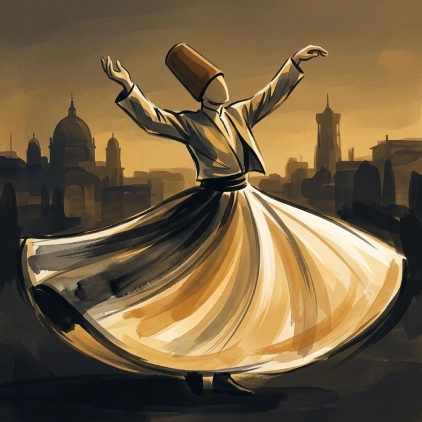
As the whirling dervishes turn in the Sema ceremony, they unite with the galaxies, the stars, and every particle of the universe, adding their own melody to this divine chorus. Their turning is a celestial journey, rising above the weight of the physical world on the wings of love, toward the Sun of Suns.
In the Sema ceremony, one hand of the dervish turns toward the sky, and the other toward the earth. Its meaning is this: “We distribute, without discrimination, the grace and love we receive from our Creator to all of humanity and all creation.” The conversation of these people of the heart in this sacred space
needs no letters, no words. They speak to one another without lips or language, for they know that light does not clash with light, that radiance does not oppose brightness, that spring does not war with greenery, and that the ocean does not dry up a single drop.
Their silent, wordless harmony exists to free humanity from division, and to lead it back to that pure, unifying oneness at its core.
A person of true compassion, moved by this deep inner mercy, embraces not only their own faith or their own people, but the entire world. Their compassion even extends beyond humanity, to all living things. They see everything in nature, every creature, as part of their own family.
On this remarkable journey, we look toward tomorrow with hope, carrying within our hearts the seeds of love and peace we have gathered along the way.
Though our languages, our beliefs, and our paths may differ, we wish to declare once again that the beauty we each whisper and tell is, in the end, one and the same.